Cash Advances Have No Grace Period: Interest From Day One
Unlike purchases, a credit card cash advance starts charging interest the day you take it — no grace period, a fee of $10 or 5%, and an APR near 30%.
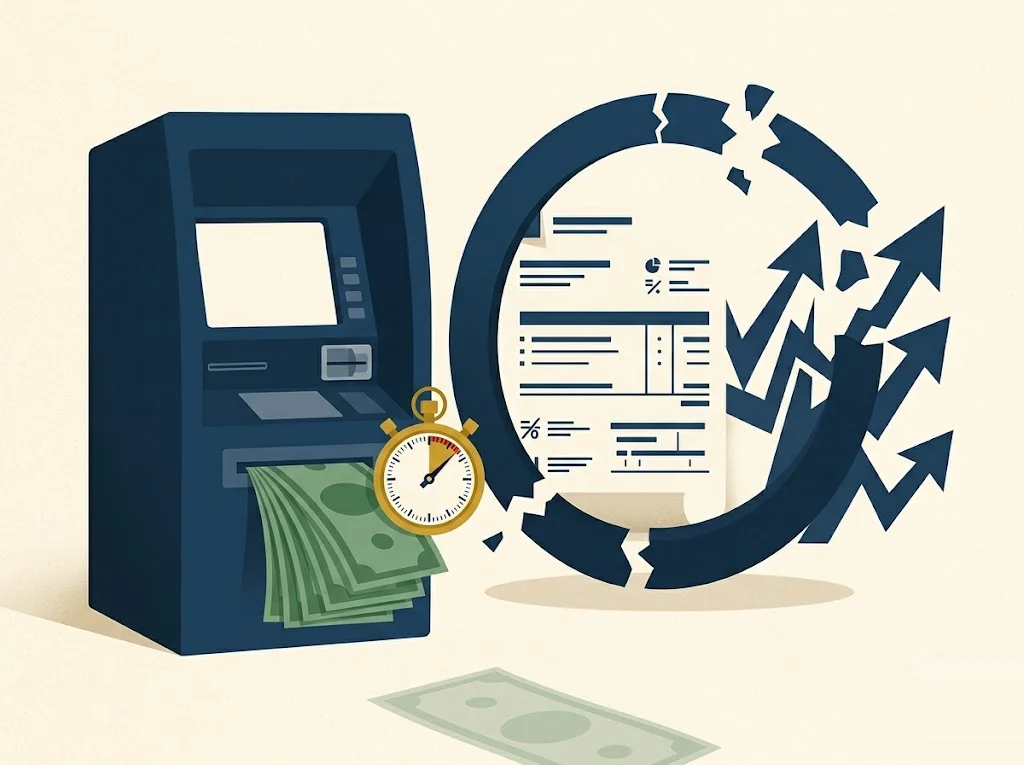
A cash advance is the most expensive button on your credit card, and almost nothing about it warns you. You insert the card at an ATM, punch in a PIN, and take out $400 the same way you would from a debit card. But the two transactions could not be more different. The debit withdrawal spends your own money. The cash advance is a loan that begins charging interest the instant the bills leave the machine — no grace period, no warning, often at an annual rate close to 30%. This guide explains exactly why, what it costs, and the two traps that make cash advances quietly worse than they look.
The short answer: A credit card cash advance has no grace period. As the Consumer Financial Protection Bureau puts it, you “generally must start paying interest as of the date of the transaction.” On top of day-one interest at a cash advance APR the CFPB found is most commonly 30%, you pay an upfront fee of the greater of $10 or 5%. There is no way to dodge the interest the way you can with purchases; the only defense is to repay it immediately.
What a grace period actually protects
A grace period is the stretch between the end of a billing cycle and your payment due date during which purchases do not accrue interest — provided you pay your statement balance in full. The CFPB describes it plainly: “you may not be charged interest as long as you pay your balance in full by the due date.” Federal law backs the timing. Under the CARD Act, issuers must mail or deliver your bill at least 21 days before the payment is due, which is where the familiar three-week window comes from.
That protection is the whole reason a credit card can be free to use. Pay in full every month and your purchases cost you nothing in interest. But the grace period is a privilege attached to one category of transaction — purchases — and a cash advance is not a purchase.
Why the meter starts immediately
For a cash advance, the CFPB is explicit: “If you use your card to get a cash advance or use a check you received from your card issuer, generally you must start paying interest as of the date of the transaction.” There is no 21-day window. There is no “pay in full to avoid interest.” From the moment you take the money, interest compounds at the cash advance APR.
And that APR is steep. In its review of card agreements, the CFPB found the most common cash advance APR is 30%, typically several points above the same card’s purchase rate. Combine an immediate start with a 30% rate and a flat fee, and the cost mounts fast.
Trap one — the minimum payment leaves it alive
Here is the mechanic almost no one knows. You take a cash advance, resolve to pay it down, and dutifully send your minimum payment each month. Yet the advance barely shrinks. Why?
Because of how federal law requires payments to be allocated. Under the CARD Act and Regulation Z §1026.53, only the amount you pay above the minimum must be applied to your highest-APR balance first. The minimum payment itself can be — and usually is — applied to your lowest-APR balance, which is typically your purchases. So your cash advance, sitting at the highest APR on the card, keeps compounding at 30% while your minimum payments quietly retire cheaper purchase debt.
The lesson is direct: paying the minimum does not meaningfully touch a cash advance. To kill it, you have to pay well above the minimum, and keep doing so until it is gone. For the broader picture of how minimums are designed and why they trap balances, see our breakdown of minimum payment math.
Trap two — transactions disguised as cash
A cash advance is not only an ATM withdrawal. Issuers code a whole list of transactions the same way — each one triggering the fee, the higher APR, and the missing grace period:
- Convenience checks the issuer mails you
- Wire transfers and money orders
- Buying cryptocurrency
- Peer-to-peer transfers funded by a credit card
- Casino chips and online gambling deposits
That last category is why the CFPB flagged a spike in cash advance fees after the spread of legal sports betting: bettors funding accounts with credit cards were taking cash advances without realizing it, paying the fee and the 30% rate on every deposit. The Bureau’s warning is that these charges “may be disguised in unexpected ways.” If you are about to use a credit card for anything that looks like cash, assume it is a cash advance until you confirm otherwise.
How to avoid the cost
The cleanest defense is simply not to take one — a debit card, an emergency fund, or even a 0% APR purchase card used for the underlying expense all beat a cash advance. When you genuinely cannot avoid it, three rules limit the damage.
| Move | Why it helps |
|---|---|
| Borrow the smallest amount possible | The 5% fee and 30% interest both scale with the amount |
| Repay it the same day or within days | Interest accrues daily from the transaction date — speed is the only lever on interest |
| Pay far above the minimum | Regulation Z sends only above-minimum dollars to the 30% balance |
One last point worth internalizing. With a purchase, discipline is rewarded: pay in full and you owe nothing. A cash advance removes that escape hatch entirely. There is no version of a cash advance where paying on time keeps it free — the interest started the day you took it. Treat the cash advance feature as a genuine last resort, and when you do use it, get out as fast as you can. For how the grace period works on the purchases side, and how to protect it, see our guide to the credit card grace period.
Quick answers
Does a credit card cash advance have a grace period?
No. The Consumer Financial Protection Bureau states that when you take a cash advance, you generally must start paying interest as of the date of the transaction. The grace period that protects purchases — the roughly 21-day window in which you can avoid interest by paying your statement balance in full — does not apply to cash advances. Interest begins the moment you withdraw the money, and there is no way to avoid it except by repaying the advance as quickly as possible.
How much does a credit card cash advance cost?
Three charges stack up. First, an upfront cash advance fee, which most issuers set at the greater of $10 or 5% of the amount. Second, interest at the cash advance APR, which the CFPB found is most commonly 30% — usually higher than the purchase APR — and which accrues from day one. Third, possible ATM operator fees. The CFPB illustrates a $400 advance at 30% APR costing about $10 in interest plus a $20 fee within a single month, an effective annual rate near 90%.
Does paying the minimum pay off a cash advance?
Not efficiently. Under the CARD Act and Regulation Z, only the portion of your payment above the minimum must be applied to the highest-APR balance first. The minimum payment itself can be applied to your lowest-APR balance — usually purchases. That means a cash advance, which typically carries your highest APR, can keep accruing interest at 30% while your minimum payments chip away at cheaper purchase debt. To kill a cash advance fast, pay well above the minimum.
What transactions count as a cash advance?
More than ATM withdrawals. Issuers also treat convenience checks, wire transfers, money orders, buying cryptocurrency, peer-to-peer transfers funded by a credit card, casino chips, and online gambling deposits as cash advances. Each triggers the cash advance fee, the higher cash advance APR, and the absence of a grace period. Because these can be disguised, the CFPB warns consumers to check how a transaction will be coded before using a credit card for anything that resembles cash.
Educational content only. finbarrow is an independent editorial publication, not a licensed financial advisor, broker, tax preparer, or attorney. Verify rates and terms with the issuer or relevant regulator. See disclaimers and funding disclosures.