First 2027 COLA payment dates: Dec 31, 2026, then Jan 13, 20, 27
The official 3.6% Social Security COLA is effective for December 2026 and payable in January. First-payment dates by birthday group, plus check examples.
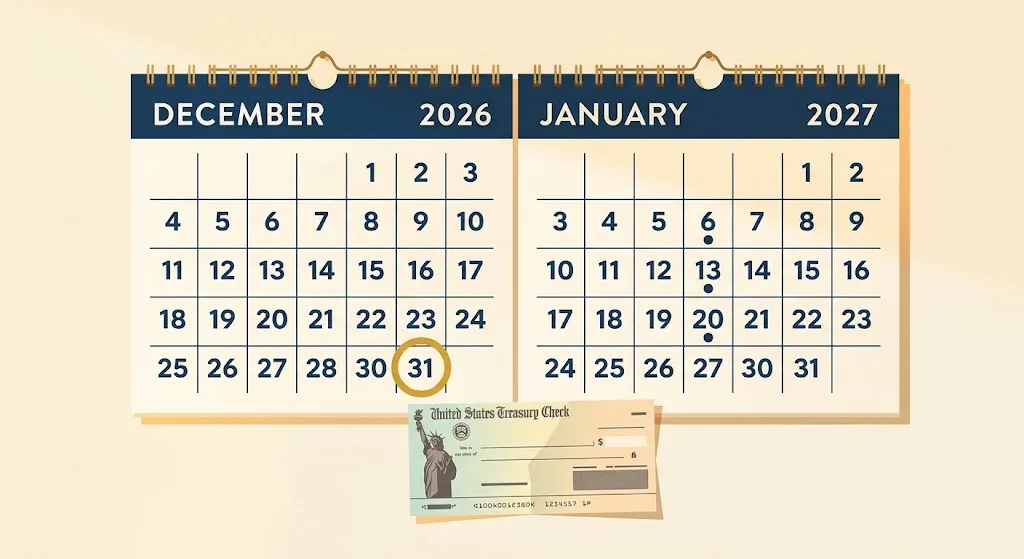
Every autumn, the Social Security Administration announces a percentage and the conversation stops there. But the percentage is not the payment, and the payment is not the announcement. For 2027, arithmetic and a federal holiday combine to produce a strange result: the first checks that carry the new cost-of-living adjustment go out before the year the adjustment is named for even ends. Some beneficiaries will see it on December 31, 2026.
The short answer: the official 2027 COLA is 3.6 percent, effective for the December 2026 benefit, and Social Security pays that benefit in January 2027 on a schedule set by birth date. Two groups get there first, on Thursday, December 31, 2026, because January 1, 2027 is a federal holiday that pushes their normal payment date backward into the prior year. Everyone else sees the increase on one of three Wednesdays in January.
| Group | First payment with the 2027 COLA |
|---|---|
| SSI recipients | Thursday, December 31, 2026 |
| Social Security paid on the 3rd (e.g., entitled before May 1997, or also on SSI) | Thursday, December 31, 2026 |
| Born on the 1st–10th | Wednesday, January 13, 2027 |
| Born on the 11th–20th | Wednesday, January 20, 2027 |
| Born on the 21st–31st | Wednesday, January 27, 2027 |
The rest of this page walks through why the table looks the way it does, because the reasoning is more useful than the dates alone — it is the same reasoning that determines every Social Security payment date, not just this one.
Why December, not January
The statute that creates the COLA is specific about when it takes effect, and the wording matters more than most coverage lets on. Under 42 U.S.C. 415(i)(2)(B), “the increase provided by subparagraph (A) with respect to a particular cost-of-living computation quarter shall apply in the case of monthly benefits under this subchapter for months after November of the calendar year in which occurred such cost-of-living computation quarter.” The computation quarter for the 2027 COLA is July through September of 2026, so the increase applies to benefit months after November 2026 — which means it starts with December 2026, not January 2027.
That single clause is the reason this page exists. Most people assume a “2027 COLA” must first appear in a 2027 payment. It does not. It first appears in the benefit calculated for December 2026, a month that is still, by the calendar, 2026.
Social Security pays a month behind
The second piece of the puzzle is that Social Security retirement, survivor, and disability benefits are paid in arrears. The check issued in a given month is payment for the previous month, not the current one. December 2026 benefits, the first to include the COLA, are therefore paid in January 2027 for most recipients. That is the mechanical reason the increase generally shows up as a January event, even though the statute effective date is December.
There is one narrow exception, and it is the reason the December 31 date exists at all.
The payment calendar, from the regulation
The rule that assigns each beneficiary a specific payment day is 20 CFR 404.1807. Its core text reads: “Insured individuals born on the 1st through the 10th of the month will be paid on the second Wednesday of each month. Insured individuals born on the 11th through the 20th of the month will be paid on the third Wednesday of each month. Insured individuals born after the 20th of the month will be paid on the fourth Wednesday of each month.” Applied to January 2027, where the Wednesdays fall on the 6th, 13th, 20th, and 27th, the second, third, and fourth Wednesdays are January 13, January 20, and January 27 — the three dates in the table above.
The same regulation preserves a legacy schedule for a shrinking group: “If you or any other person became entitled to benefits on the earnings record of the insured individual based on an application filed before May 1, 1997, you will continue to receive your benefits on the 3rd day of the month.” For most months, the 3rd is simply the 3rd. January 2027 is not most months, because January 3, 2027 falls on a Sunday.
That is where the regulation’s holiday rule takes over: “If the day regularly scheduled for the delivery of your benefit payment falls on a Saturday, Sunday, or Federal legal holiday, you will be paid on the first preceding day that is not a Saturday, Sunday, or Federal legal holiday.” Walking backward from Sunday, January 3, the preceding day is Saturday, January 2, also excluded. Before that is Friday, January 1 — New Year’s Day, a federal holiday, also excluded. The next day back is Thursday, December 31, 2026, which clears every condition. That is the payment date for anyone still on the pre-1997 day-3 schedule, and because it is payment for the December 2026 benefit, it is the first Social Security payment anywhere to carry the 2027 COLA.
The SSI case: a different rule, the same December 31
Supplemental Security Income runs on separate rules from Social Security retirement and disability benefits, and it happens to land on the identical date for a different reason. Under 20 CFR 416.502, “a payment will be made on the first day of each month and represents payment for that month. If the first day of the month falls on a Saturday, Sunday, or legal holiday, payments will be made on the first day preceding such day which is not a Saturday, Sunday, or legal holiday.”
Two things are different here, and both matter. First, SSI pays for the current month, not the prior one — the January payment represents January, not December. Second, the SSI increase takes effect with the payment for January 2027; the Social Security Administration words it the same way in its annual Federal Register determinations, where the new SSI rates are stated as effective for payments made for January. So the first SSI payment at the new rate is the January payment, wherever the calendar happens to deliver it. What the holiday rule changes is only the delivery date: January 1, 2027 is a Friday and a federal holiday, so the preceding non-weekend, non-holiday day is Thursday, December 31, 2026. SSI recipients therefore receive their COLA-inclusive January payment on the last day of December. Because January 1, 2028 is a Saturday, the same thing happens a year later, so December 2027 also carries two SSI payments; the full calendar is in SSI payment 2027. VA disability compensation, by contrast, only gets the 2027 increase once Congress passes the annual COLA act; the projected chart is in VA disability rates 2027.
Finding your own group
Two questions settle which row of the table applies to you. Do you receive SSI, Social Security, or both? If SSI, your answer is December 31, 2026, regardless of birth date, because SSI eligibility does not use the birth-date calendar at all. If you receive Social Security and your benefit began before May 1997 on the record in question, check whether that day-3 schedule still applies to you; if so, your first COLA payment is also December 31, 2026. The same regulation also assigns the 3rd to records based on applications filed after April 30, 1997 when a beneficiary also receives SSI, lives in a foreign country, or has the Medicare premium paid by the state (20 CFR 404.1807(c)(2) through (4)), so those payees land on December 31, 2026 as well.
Everyone else uses birth date alone. Born the 1st through the 10th, the payment lands on the second Wednesday of the month — January 13, 2027. Born the 11th through the 20th, the third Wednesday, January 20. Born after the 20th, the fourth Wednesday, January 27. The Social Security Administration publishes the full year in its Schedule of Social Security Benefit Payments 2027, which is the primary source behind the January dates on this page (the December 31, 2026 payments appear in the 2026 edition) and the one worth bookmarking for months beyond January.
What the official 3.6 percent does to a check
The percentage is no longer an estimate. The Social Security Administration announced on October 14, 2026 that the 2027 COLA is 3.6 percent, and the formal determination is Federal Register document 2026-21796. The calculation behind it, and how it compared with our earlier projected band, is in the 2027 Social Security COLA tracker. Multiplying a monthly benefit by 1.036 gives the new gross amount:
| Benefit before the COLA | × 1.036 | Gross raise |
|---|---|---|
| $1,500 | $1,554 | $54 |
| $2,000 | $2,072 | $72 |
| $2,500 | $2,590 | $90 |
Real benefits rarely land on round numbers, and rounding runs one way. The statute rounds a COLA-adjusted amount down to the next lower dime, and the payment itself goes out in whole dollars rounded down. A $1,847 benefit times 1.036 is $1,913.49, so the January deposit before any deductions is $1,913, a raise of $66 rather than the $66.49 the multiplication suggests. For comparison, the SSA says the average retirement benefit rises by $75 a month.
These are gross figures. The Medicare Part B premium, still a projection until CMS publishes it in November, comes out of most checks first; our breakdown of the 2027 COLA net of Medicare Part B shows what is left.
It is also worth separating the announced percentage from the number that actually lands in a bank account. What most recipients notice is the net change after the Medicare Part B premium is deducted, since that premium is set separately and can absorb a meaningful share of the raise. The Medicare hold-harmless provision explains the rule that caps how much a Part B increase can cut into the dollar amount of a COLA for existing beneficiaries. If you are still working while collecting, the Social Security earnings test is the other 2026-into-2027 mechanic worth knowing, since it interacts with the same January payment calendar.
Both halves of the story are now settled: the dates in the table above and the 3.6 percent behind them. The one open number is the Part B premium, which CMS announces in November.
Sources
- Social Security Administration, “Cost-of-Living Increase and Other Determinations for 2027,” Federal Register document 2026-21796.
- Social Security Administration, “Social Security Announces 3.6 Percent Benefit Increase for 2027,” press release, October 14, 2026.
- 20 CFR 404.1807 and 20 CFR 416.502, payment dates.
Quick answers
When will I see the 2027 COLA in my Social Security payment?
The 2027 COLA is effective for the December 2026 benefit, which Social Security pays in January 2027 because benefits are paid a month behind. If you are paid on the 3rd of the month (for example, your entitlement began before May 1997 or you also receive SSI), your day-3 payment lands early, on December 31, 2026, since January 3, 2027 falls on a Sunday. Everyone else sees the increase in the January 2027 payment tied to their birth date.
Why does my neighbor get the COLA increase before me?
Social Security pays on a staggered calendar tied to birth date and, for a small group, to when benefits started. People born on the 1st through the 10th are paid the second Wednesday of the month; the 11th through the 20th, the third Wednesday; after the 20th, the fourth Wednesday. A small group who started benefits before May 1997 is still paid on the 3rd, which is why that payment can land earlier than the Wednesday schedule most people are on.
Is the January 2027 payment the December 2026 benefit?
Yes, for Social Security. Benefits are paid the month after they are earned, so the payment issued in January 2027 covers December 2026, the first month the 2027 COLA applies under 42 U.S.C. 415(i)(2)(B). Supplemental Security Income works differently; it pays for the current month, so its January payment already carries the new rate, and a holiday shift moves that payment to December 31, 2026.
How big is the 2027 COLA, and when was it announced?
The Social Security Administration announced on October 14, 2026 that the 2027 cost-of-living adjustment is 3.6 percent, the day the September Consumer Price Index for Urban Wage Earners and Clerical Workers was published. It applies to the December 2026 benefit. A $2,000 monthly benefit becomes $2,072, and the SSA puts the average retirement increase at $75 a month.
Educational content only. finbarrow is an independent editorial publication, not a licensed financial advisor, broker, tax preparer, or attorney. Verify rates and terms with the issuer or relevant regulator. See disclaimers and funding disclosures.